Skip to content
Web Designers Dubai

Website Development Services in Dubai

We turn approved designs into fast, accessible websites. Our website development work in Dubai covers responsive front-end builds, custom features and integrations with the tools you already use, all tested properly before launch.

What this covers

  • Custom, static and headless builds
  • Forms, APIs and third-party integrations
  • Performance and security built in
  • Cross-browser and device testing

Website development in Dubai, from approved design to live site

A design shows how a website should look. Development decides how well it actually works: how quickly pages load, whether forms reach the right inbox, how the site behaves on an older phone and how easy it is to change a year from now. Most of those decisions are invisible to visitors, which is exactly why they need care.

We build from designs created through our website design service, or from approved designs supplied by your own team or another designer. The technology is chosen to suit the project. Content-led business sites often work well on a modern static-site framework or a headless CMS, while others are better suited to WordPress. Our comparison of WordPress and custom development explains the trade-offs in plain terms.

Whichever route you choose, every build goes through structured testing on a staging copy, and we help with domain and hosting setup so the move to a live site is planned rather than rushed.
Custom website development for business websites

Custom development means the site is built around how your business works, not around the limits of a theme. We write clean, maintainable code and choose the stack once we understand your content, features and who will update the site.

  1. Modern static-site frameworks

    For content-led business sites, pages are generated ahead of time and served as lightweight files. They tend to load quickly, are straightforward to host and leave very little for attackers to target.

  2. Headless CMS setups

    Your team edits content in a friendly CMS while the front end is built separately. This suits sites with structured content, frequent publishing or content that needs to appear in more than one place.

  3. Business websites with room to grow

    Corporate and SME sites with service pages, sector pages, careers, news and resources, structured so new sections can be added later without rebuilding what is already there.

  4. Landing pages and microsites

    Standalone pages for campaigns, product launches or events, built to match your main brand, connected to your forms and tracking, and easy to retire when the campaign ends.

  5. Clean handover

    Code kept in version control, plus a short guide to how the site is structured and how content is edited, so future changes do not depend on one person remembering how it was built.

Front-end and back-end development

The front end is everything visitors see and interact with in the browser. The back end handles data, logic and connections to other systems. We build the front end on every project and add back-end features only where the project genuinely needs them.

  • Semantic, accessible HTML

    Proper headings, landmarks, labels and alt text give search engines and assistive technology a clear picture of each page, and make the code easier to maintain over time.

  • Responsive layouts that match the design

    Fluid grids, flexible type and components that adapt at each breakpoint, built to match the approved design closely on phones, tablets, laptops and large monitors.

  • Interactions with restraint

    Menus, accordions, tabs, carousels and subtle animation that respond quickly, respect reduced-motion settings and never stop someone from reading the page or tapping a button.

  • Server-side features where needed

    Form processing, file uploads, gated downloads or member-only content, built only when the project calls for it, with proper validation and access limited to the right people.

  • Content models that make sense to editors

    Fields and content types shaped around how your team works, so adding a project, a job opening or an article means filling in a form rather than editing page layouts.

Integrations and custom features

Your website should connect to the systems you already run. Where a tool offers an API or an official integration, we connect it so enquiries and bookings land where your team expects them. Our guide to essential website features covers what most businesses need.

  • CRM integration

    Form submissions sent straight into tools such as HubSpot, Zoho CRM or Salesforce, with fields mapped and the lead source recorded so you can see where enquiries come from.

  • Booking and scheduling

    Booking tools connected or embedded for consultations, viewings, appointments or table reservations, so visitors can choose a time without a back-and-forth by phone or email.

  • Email marketing sign-ups

    Newsletter and download forms connected to platforms such as Mailchimp or Brevo, with consent captured clearly and new contacts tagged by their interest or the page they came from.

  • WhatsApp click-to-chat

    Click-to-chat buttons with pre-filled messages, so a visitor viewing a specific service or property can start a conversation that already tells you what they were looking at.

  • Maps, calculators and custom tools

    Location maps, quote estimators, property or project filters and other interactive tools, scoped and built around the specific job your visitors are trying to get done.

  • Analytics and conversion tracking

    Analytics and tag management set up with key events such as form submissions and calls, and a cookie consent approach agreed with you before any tracking goes live.

Performance and security

Speed and security are easier to build in than to bolt on later. We develop against Google's Core Web Vitals and aim for the 'good' thresholds: LCP within 2.5 seconds, INP within 200 milliseconds and CLS of 0.1 or less. More on this in how to improve website speed.

  • Lean pages and optimised assets

    Modern image formats, correctly sized images, efficiently loaded fonts and minimal JavaScript, so pages stay quick even on a patchy mobile connection or an older device.

  • Caching and content delivery

    Sensible caching rules and a content delivery network where the hosting supports one, so visitors in the UAE and abroad receive pages from a server close to them.

  • HTTPS and security headers

    SSL on every page, security headers configured, and admin areas kept away from the public site where the stack allows, reducing what automated attacks can reach.

  • Spam and abuse protection

    Form validation, rate limiting and spam filtering, such as hidden honeypot fields or a privacy-friendly challenge, so your inbox receives genuine enquiries rather than bot traffic.

  • Privacy-aware data handling

    If your forms collect personal data, UAE Federal Decree-Law No. 45 of 2021 on personal data protection may apply. We add consent wording and privacy links; your legal adviser should confirm what your business needs.

Testing and launch

A launch should be uneventful for your visitors. We test against a written checklist, fix what we find on a private staging copy, and only then move the site to its live domain, with checks continuing after go-live.

  1. Cross-browser and device testing

    Layouts and interactions checked in current versions of Chrome, Safari, Edge and Firefox, on iOS and Android phones as well as tablets and desktop screens.

  2. Form and integration checks

    Every form submitted end to end, confirming that notification emails arrive, CRM records appear and thank-you pages and tracking events fire as expected.

  3. Accessibility and content review

    Keyboard navigation, focus order, colour contrast, alt text and heading structure reviewed, alongside a final pass for broken links and leftover placeholder content.

  4. Technical SEO before go-live

    Page titles, meta descriptions, an XML sitemap, robots rules, canonical tags and structured data in place from day one. Our SEO services can take it further after launch.

  5. Domain, hosting and go-live

    We help you set up hosting, point your domain and configure SSL, checking that existing email records are preserved so your inbox keeps working through the switch.

  6. Support after launch

    Where agreed, we provide ongoing maintenance covering updates, backups, monitoring and small changes, so the site stays secure and current after handover.

Examples from our portfolio

Concept projects that show how we approach this kind of work. Each case study explains the goals, design decisions and build approach.

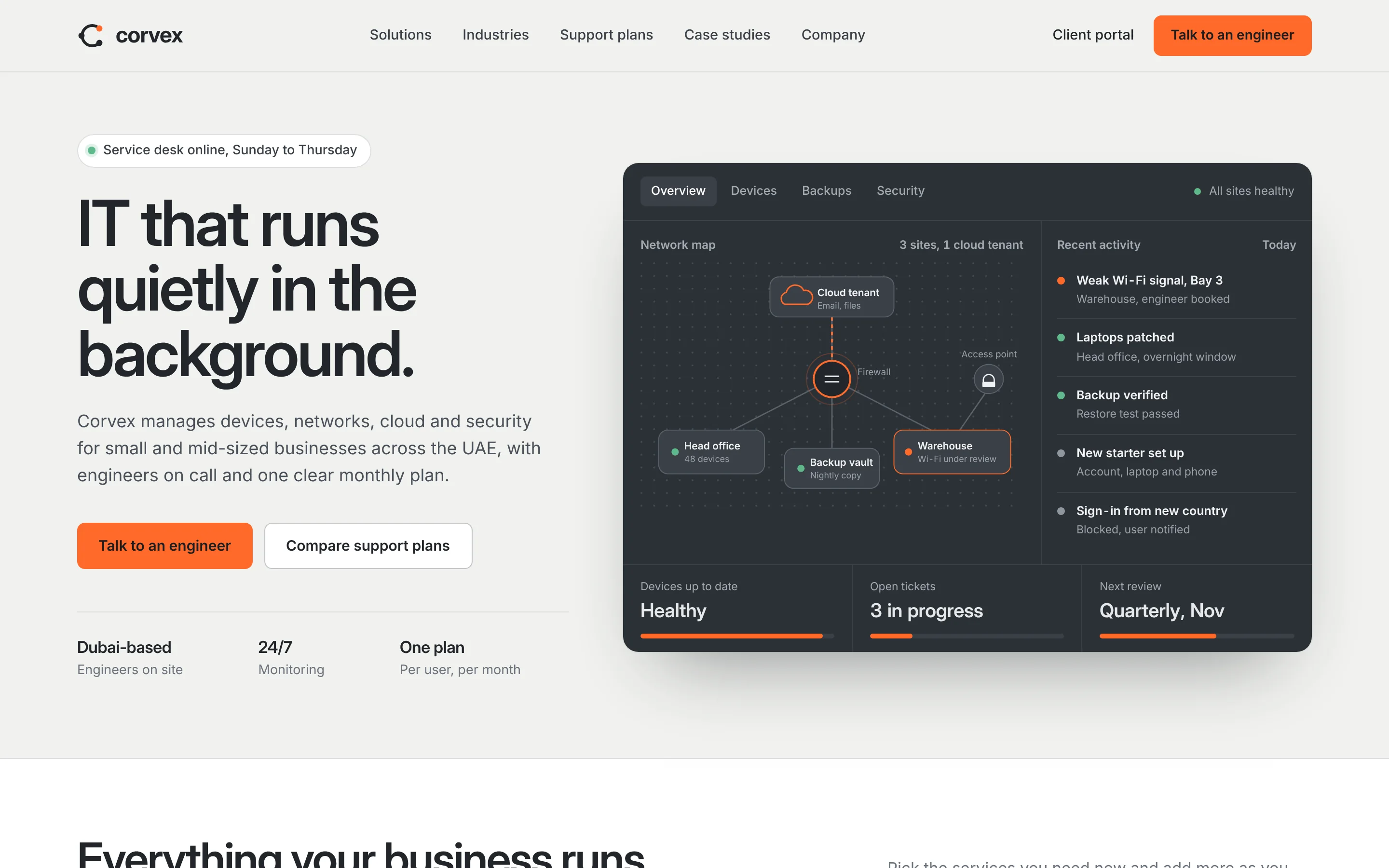
Corvex Systems homepage concept with a large sans-serif headline, an orange call to action and a graphite monitoring dashboard showing a network map and recent activity
IT managed services and cloud Concept project

Corvex Systems

A crisp, technical website concept for an IT managed-services and cloud company that supports small and mid-sized UAE businesses.

Services: Web design, Website development, Technical SEO setup

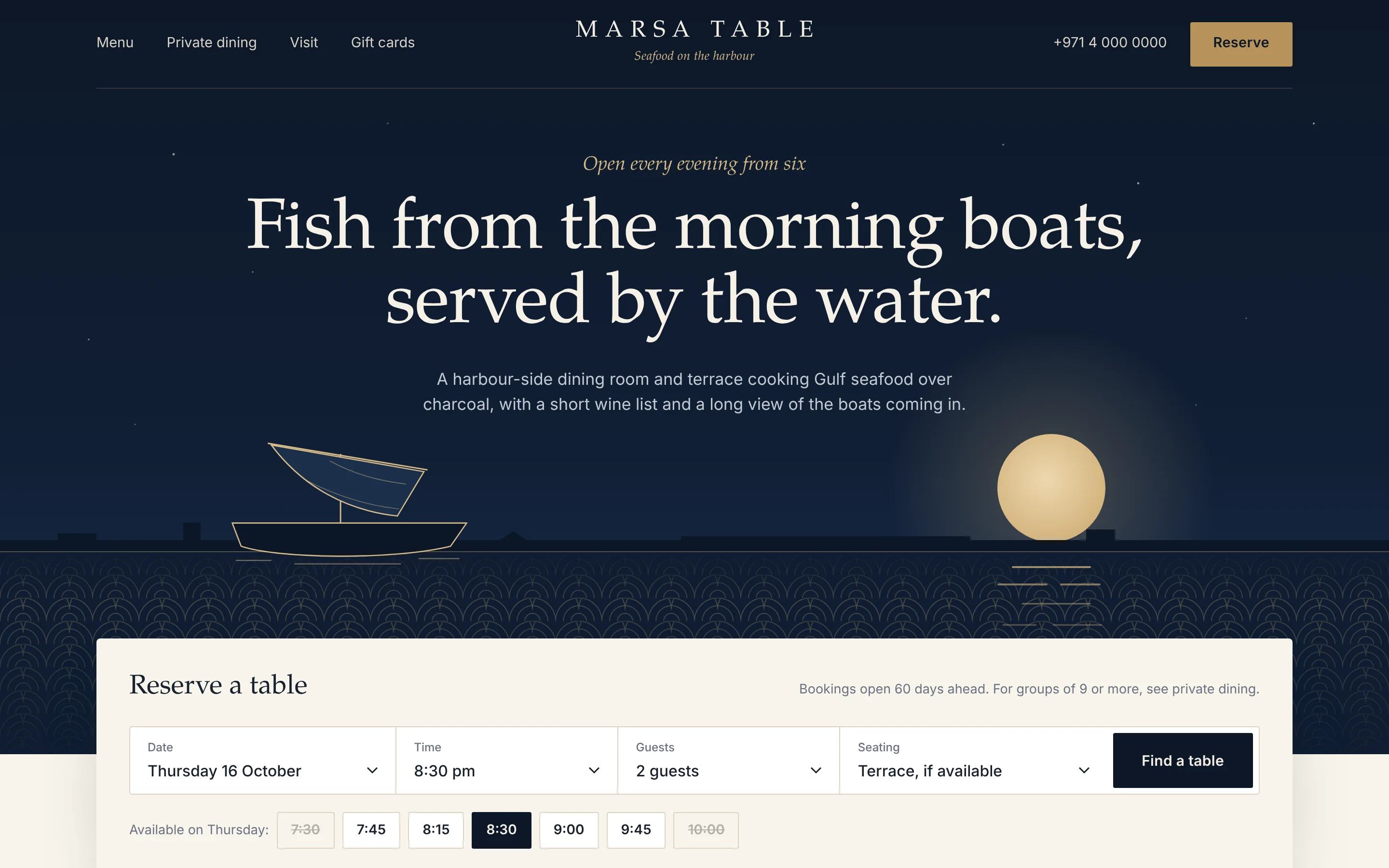
Marsa Table homepage concept in deep navy with a centred serif headline, a brass line drawing of a dhow and rising moon over a patterned sea, and a table booking panel
Restaurants and hospitality Concept project

Marsa Table

An evening-toned website concept for a waterfront seafood restaurant, built around a booking widget and a typographic menu.

Services: Web design, Website development

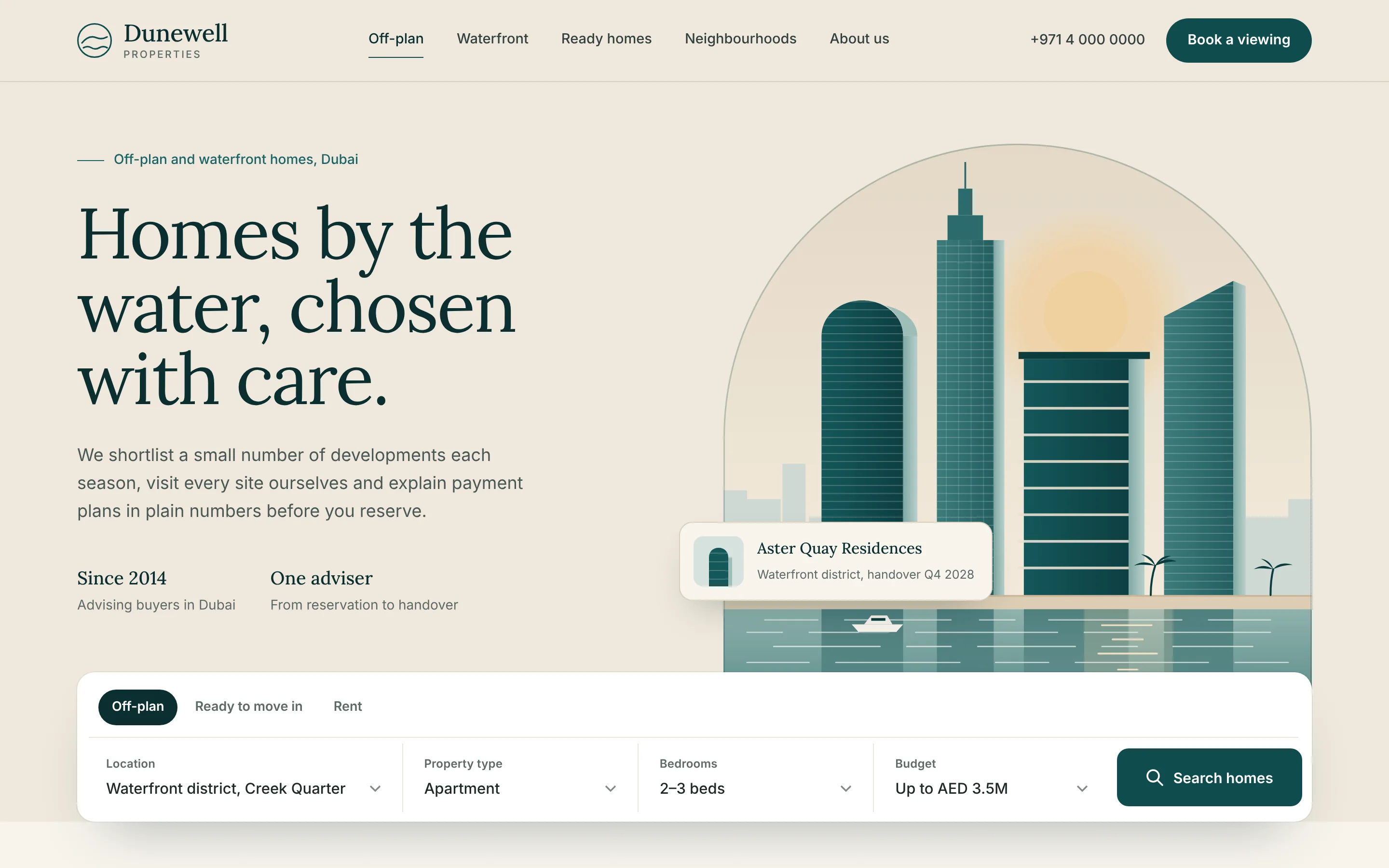
Dunewell Properties homepage concept with a serif headline, an arched illustration of waterfront towers at dusk and a property search bar across the hero
Real estate Concept project

Dunewell Properties

A calm, search-first website concept for a boutique Dubai brokerage selling off-plan and waterfront homes.

Services: Web design, Website development

What affects the cost of website development

Development cost follows complexity. A clear design and a defined feature list make it possible to quote accurately, and we break the proposal down so you can see where the effort goes.

Get a Free Quote
  • The number of page templates and reusable components to build
  • The chosen approach: a static-site framework, a headless CMS or WordPress
  • Integrations with CRMs, booking tools, email platforms or other systems, and how well their APIs are documented
  • Custom features such as calculators, filters, member areas or file uploads
  • Content migration from an existing website, including how much needs reformatting
  • Accessibility, performance or security requirements beyond our standard checks
  • Hosting setup, and whether ongoing maintenance is included after launch

A Clear Process From Concept to Launch

You always know what happens next, what we need from you and when you will see progress.

  1. 1

    Discover

    We learn about your business, your customers, your goals and what the website needs to do.

  2. 2

    Design

    We plan the page structure and user experience, then create the visual direction for your approval.

  3. 3

    Develop

    We build the responsive website and test it on real phones, tablets and desktop browsers.

  4. 4

    Launch & support

    We launch the site, hand over your logins and provide the support we have agreed with you.

Website Development: frequently asked questions

Straight answers to what clients usually ask before starting. Ask us if your question is not covered.

Ask a Question

What is the difference between website design and website development?

Design decides what the site looks like and how people move through it: layouts, typography, colour and user journeys. Development turns those designs into working code, connects forms and integrations, makes pages load quickly and prepares the site for launch. We offer both, either as one project or separately if you already have approved designs from another designer or an in-house team.

Which technology will you use to build my website?

We choose after scoping, not before. Content-led sites often suit a modern static-site framework, sometimes paired with a headless CMS so your team can edit content. If you want a large plugin ecosystem and familiar editing, WordPress may be the better fit. We explain the trade-offs in plain terms, including hosting, maintenance and who will update the site, before you decide.

Can you integrate my website with our CRM or booking system?

Usually, yes, if the system offers an API, webhooks or an official integration. Common examples are sending enquiries to a CRM, connecting a booking calendar or adding newsletter sign-ups to an email platform. We check the documentation during scoping, confirm what is possible and flag any limits, such as features that need a paid plan on the software side, before it goes into the proposal.

Will my website be fast?

Speed is part of how we build, not an afterthought. We optimise images, limit scripts, use caching and test key pages against Google's Core Web Vitals, aiming for the 'good' range. Real-world speed also depends on hosting, third-party scripts such as chat widgets or advertising tags, and content added after launch, so we explain how to keep the site fast once it is live.

How do you test a website before it goes live?

We build on a private staging copy and work through a checklist covering layouts across browsers and devices, form submissions, integrations, accessibility basics, broken links, page titles, redirects and tracking. You review the staging site as well. Once everything is signed off, we plan the go-live, including domain and DNS changes, so your email and existing services are not disrupted.

Can I update the website myself after launch?

In most cases, yes. We set up a content management system suited to the build, whether a headless CMS or WordPress, and structure it so routine edits to text, images, projects or articles do not need a developer. Structural changes, new features or new page types are better handled by us, either as one-off work or under a maintenance plan where agreed.

Do you provide website hosting?

We help you choose and set up hosting that suits the build, then connect your domain and configure SSL. We recommend keeping the hosting and domain accounts in your business's name, so you always stay in control of them. If you would rather not deal with updates and monitoring yourself, we can discuss a maintenance arrangement once the site is live.

Web Design

Custom, mobile-first website design that makes your business easy to understand and easy to contact.

WordPress Websites

Custom WordPress websites that look like your brand and are easy for your team to update, built with care for speed and security.

eCommerce Websites

Online stores on WooCommerce or Shopify, designed for easy browsing and a clear checkout, with UAE payment and delivery set up.

Have a website project in mind?

Tell us what the site needs to do, the systems it should connect to and any designs you already have. We will come back with questions or a scoped proposal.

  • Free, no-obligation quote
  • Fixed scope agreed in writing before work starts
  • Based in Dubai, working with businesses across the UAE

Fields marked with an asterisk are required.

What does your business do, what do you need, and is there anything you already have (content, logo, domain)?

Preferred contact method (optional)

We reply to every genuine enquiry, usually with a few questions or a proposal.